We talked about The IceCube Neutrino observatory beneath the Antarctic Ice with Anna Obertacke from Fysikum.
|
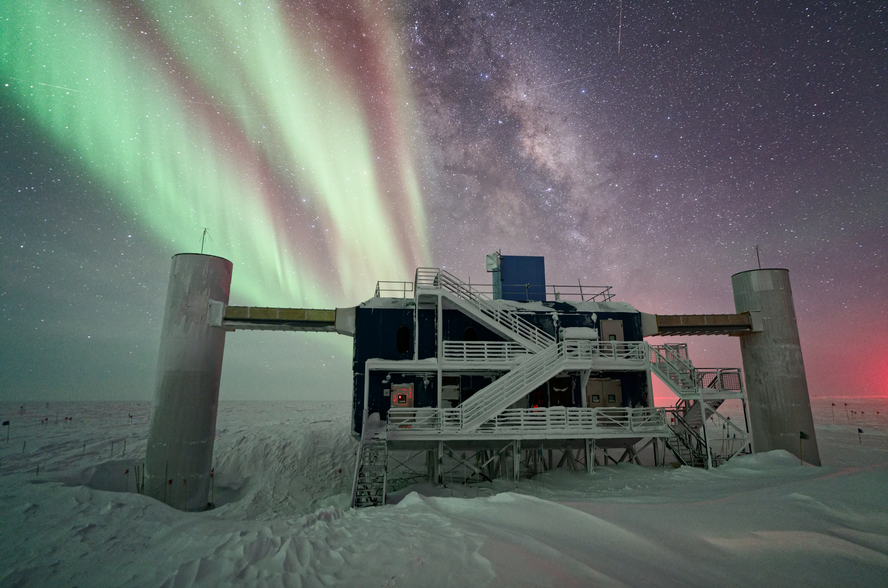 Picture and caption taken from here ; Credit: Ilya Bodo, IceCube/NSF
The IceCube Lab under a starry, night sky, with the Milky Way appearing next to striking auroras in the background.
More details on the upcoming activity :
A solar neutrino can pass through a light-year of lead without interacting even once. This is what makes neutrinos such amazing messengers: nothing gets in their way, not dust, not magnetic fields, not the galaxy itself! But this very property is also what makes them extraordinarily hard to detect!
The IceCube Neutrino Observatory solves this by using the largest available detector medium on Earth: a cubic kilometer of highly transparent Antarctic ice, instrumented with 5665 optical sensors that register the faint flash of Cherenkov light left behind on the rare occasion a neutrino does interact. In its first 15 years, IceCube measured the diffuse flux of high-energy astrophysical neutrinos for the first time and linked a few of them to a flaring blazar ( Blazars are the cores of galaxies that contain supermassive black holes ). But several open questions about the properties and origin of neutrinos remain to answer which requires a more precise instrument.
This last winter, the IceCube Upgrade was installed at the South Pole: five new, more densely instrumented strings were deployed into the ice. Among the new sensors are steerable calibration cameras, built by Stockholm and Uppsala University, that watched the ice refreeze around the new sensors in real time. In this first session of News and Views for the new academic year, Anna Obertacke, Associate Professor at the Astroparticle and Elementary Particle Physics group at Fysikum, will go through how neutrinos are detected, what specifically the upgrade improves, and what was captured when the ”Sweden cameras” were first switched on. Don't miss this first News and Views session of the new academic year!
Picture and caption taken from here ; Credit: Ilya Bodo, IceCube/NSF
The IceCube Lab under a starry, night sky, with the Milky Way appearing next to striking auroras in the background.
More details on the upcoming activity :
A solar neutrino can pass through a light-year of lead without interacting even once. This is what makes neutrinos such amazing messengers: nothing gets in their way, not dust, not magnetic fields, not the galaxy itself! But this very property is also what makes them extraordinarily hard to detect!
The IceCube Neutrino Observatory solves this by using the largest available detector medium on Earth: a cubic kilometer of highly transparent Antarctic ice, instrumented with 5665 optical sensors that register the faint flash of Cherenkov light left behind on the rare occasion a neutrino does interact. In its first 15 years, IceCube measured the diffuse flux of high-energy astrophysical neutrinos for the first time and linked a few of them to a flaring blazar ( Blazars are the cores of galaxies that contain supermassive black holes ). But several open questions about the properties and origin of neutrinos remain to answer which requires a more precise instrument.
This last winter, the IceCube Upgrade was installed at the South Pole: five new, more densely instrumented strings were deployed into the ice. Among the new sensors are steerable calibration cameras, built by Stockholm and Uppsala University, that watched the ice refreeze around the new sensors in real time. In this first session of News and Views for the new academic year, Anna Obertacke, Associate Professor at the Astroparticle and Elementary Particle Physics group at Fysikum, will go through how neutrinos are detected, what specifically the upgrade improves, and what was captured when the ”Sweden cameras” were first switched on. Don't miss this first News and Views session of the new academic year!